
In SMEs, sustainability does not begin with a separate sustainability function or with formal commitments. It begins when energy use, the choice of materials and services, employee retention and working conditions start to be seen in a broader context and gain clear business relevance. In SMEs, sustainability is more accurately understood as the relationship between specific practices and specific business outcomes, which develops differently across companies. [1].
The role of the manager is particularly important here. SME managers are often the main shapers of the company’s sustainability direction and, in many cases, pioneers of good social and environmental practices. Their decisions are influenced not only by external pressure or regulation, but also by values, company identity, relationships with the community, reputation and competitive advantage motives. [2]The strategic direction of SMEs is also strongly influenced by the manager’s own values and by the competitive advantage they see in environmental solutions. [3]At the same time, it is important to note that many SMEs engage in sustainability practices without explicitly presenting them as such publicly. [2].
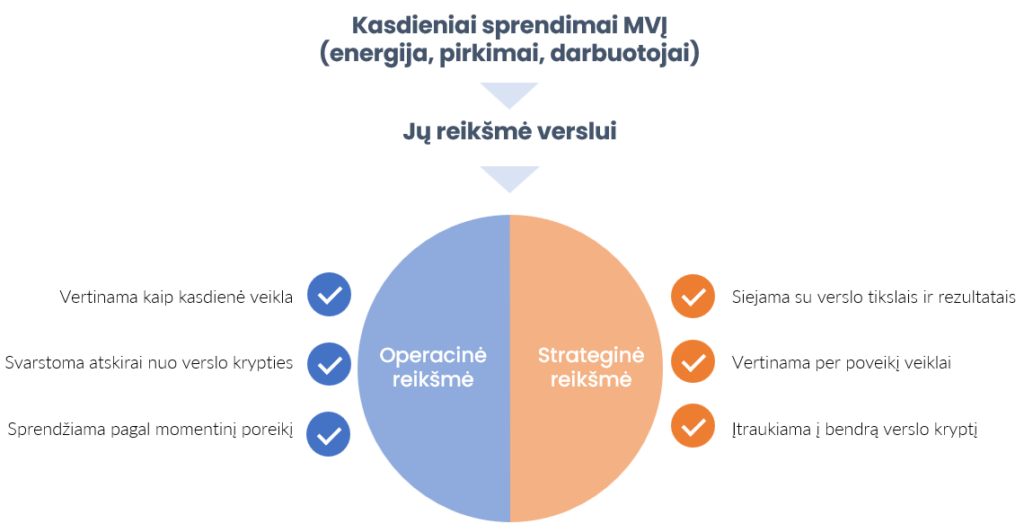
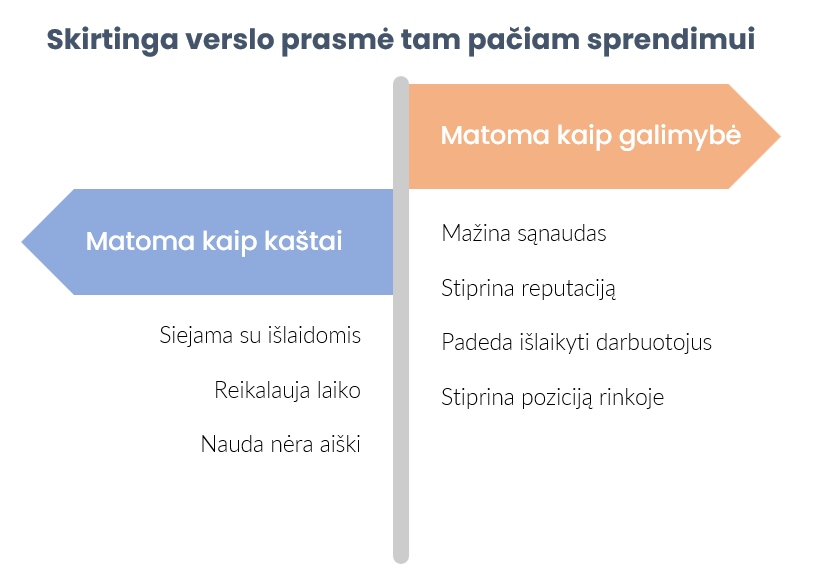
Differences between companies are not accidental. For some SMEs, environmental measures are still primarily associated with costs, time and benefits that are not always clear. [4]Others, in the same areas, see opportunities to reduce costs, strengthen reputation, attract customers, retain employees and position the business more strongly in the market. [5; 6]In the SME context, the same decisions may acquire different business meanings in different companies.
Therefore, the question of where sustainability begins in SMEs is essentially a question of managerial attention. It is not about whether the company has a separate system or report, but whether certain decisions have already started to be seen as important for the business. This is also reflected in the broader business context: sustainability decisions are increasingly emerging at management level and are more often linked to competitiveness, risk management, resilience and long-term value. [7].
Sources
[1] Zaman, M., Tanewski, G., and Ekanayake, G. (2025) ‘What does sustainability mean for small and medium enterprises: A systematic literature review’, Journal of Cleaner Production, 492, 144830.
[2] Kutzschbach, J., Tanikulova, P., and Lueg, R. (2021) ‘The Role of Top Managers in Implementing Corporate Sustainability—A Systematic Literature Review on Small and Medium-Sized Enterprises’, Administrative Sciences, 11(2), 44.
[3] Tan, L. P., Casidy, R., and Arli, D. (2025) ‘Drivers of strategic green marketing orientation: An SME owner-manager perspective’, Journal of Retailing and Consumer Services, 82, 104130.
[4] Revell, A. and Blackburn, R. (2007) ‘The Business Case for Sustainability? An Examination of Small Firms in the UK’s Construction and Restaurant Sectors’, Business Strategy and the Environment, 16(6), pp. 404–420.
[5] Revell, A., Stokes, D., and Chen, H. (2010) ‘Small Businesses and the Environment: Turning Over a New Leaf?’, Business Strategy and the Environment, 19(5), pp. 273–288.
[6] Williams, S. and Schaefer, A. (2013) ‘SMEs and sustainability: managers’ values and engagement with environmental and climate change issues’, Business Strategy and the Environment, 22(3), pp. 173–186.
[7] Bureau Veritas (2026) Trends Report 2026. Bureau Veritas.